Research

Learning the rules of cancer vulnerability

We combine perturbational experiments, functional genomics and machine learning to understand the genes and pathways that sustain cancer cells, and translate these insights into therapeutic hypotheses. Experiments inform our models; models help us decide what to test next.

Research programmes

From perturbation to prediction

01 · ERC — DepSHOCK

What happens after acute inactivation of a genetic dependency?

We extend the concept of oncogenic shock to cancer dependency genes: genes whose loss compromises cancer-cell survival. Our hypothesis is that the resulting imbalance between survival and death signals leaves a measurable transcriptional footprint that reveals the pathways sustaining each dependency.

We combine longitudinal perturbational profiling at bulk and single-cell resolution with statistical methods and unsupervised machine learning to separate shared responses from dependency-specific programmes. We investigate whether these DepSHOCK signatures can provide mechanistically grounded therapeutic markers, predictive tools and clues for combination therapies.
DepSHOCKEuropean Research Council
02 · CRISPR-VUS / DAM

Turning cancer variation into functional evidence

Large-scale functional maps connect variants of uncertain significance to cancer dependencies, molecular context and therapeutic hypotheses. We use functional evidence to investigate how cancer variation shapes the dependencies of tumour cells.

03 · Genetic interactions

Predicting beyond measured gene pairs

We develop methods that combine genome-wide single-gene perturbations with targeted combinatorial screens to infer genetic interactions. Our aim is to predict vulnerabilities beyond the gene pairs already measured, while quantifying uncertainty and prioritising interactions for experimental follow-up.

04 · AIRC — Drug sensitivity recovery

Finding vulnerabilities that reverse drug resistance

The Cancer Drug Sensitivity Recovery Map uses CRISPR screening and computational analysis to identify genetic vulnerabilities in drug-resistant cancer models across tumour types and commonly used chemotherapies.

We prioritise targets whose perturbation can restore drug sensitivity and inform combination therapies. Complementary work examines non-genetic resistance driven by the tumour microenvironment, including how factors secreted by cancer-associated fibroblasts alter drug responses in breast cancer.

AIRC Foundation for Cancer Research
Research themes

The methods and questions connecting our projects

DNA and a target: mapping genetic dependencies to therapeutic targets
Cancer dependency mapping

From genetic dependencies to therapeutic targets

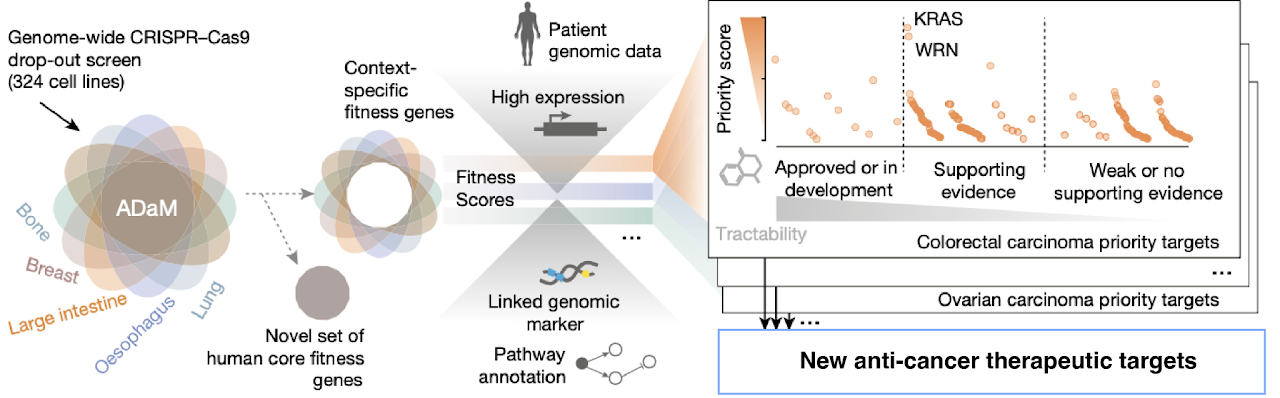
We analyse genome-wide CRISPR screens alongside genomic, transcriptomic and proteomic data to understand which genes and pathways tumours rely on for survival and growth. Through the European Cancer Dependency Map initiative, we contribute to large-scale dependency datasets and computational frameworks for target prioritisation.

We integrate molecular biomarkers and drug tractability, and use patient-derived models to help connect preclinical discoveries to therapeutic response.

Related study
Diagram connecting genome-wide CRISPR screens, cancer dependencies and new therapeutic targets
From genome-wide CRISPR screening to target prioritisation. View full-size figure ↗
DNA and scissors on a computer screen, illustrating computational analysis of CRISPR screens
CRISPR screening methods

More reliable screens. More informative experiments

We develop and maintain tools for assessing preclinical cancer models and processing, analysing and visualising genome-editing screens. Our methods correct technology-specific biases and support the design and optimisation of guide RNA libraries for pooled CRISPR-Cas9 experiments.

Explore our software and computable manuscripts
A capsule surrounded by circular arrows, illustrating drug repositioning
Drug repositioning

New therapeutic opportunities for existing compounds

We integrate disease profiles with the molecular responses induced by drugs to identify opportunities for repurposing existing compounds. Our analyses span transcriptomics, proteomics, single-cell and spatial data, looking for responses that could counter disease-associated changes.

We explore graph-based methods, representation learning and causal inference to move beyond simple signature matching. Predictions are prioritised for mechanistic plausibility and experimental follow-up with collaborators.

An older person beside a cluster of cancer cells
Cancer and ageing

How does biological age reshape cancer vulnerability?

We investigate how ageing changes cellular fitness, genetic dependencies and responses to perturbation. By combining functional genomics, multi-omic profiling and machine learning, we aim to uncover the molecular programmes linking ageing to cancer development and therapeutic response.

A particular focus is the development of ageing clocks and predictive models that capture biological age and help identify vulnerabilities emerging during ageing.

Collaborative projects

Shared data. Broader possibilities.

Open Targets

A unified view of genetic perturbation

Within the Perturbation Catalogue project, we harmonise and meta-analyse CRISPR datasets from diverse studies. We develop target-prioritisation approaches for cancer, neurodegeneration and other diseases, using shared perturbation evidence to investigate gene function and genetic vulnerabilities.

Open Targets
Open Targets
Horizon Europe — NeuroCOV

Drug repositioning for the neurological effects of COVID-19

We develop computational methods that integrate gene-expression profiles from NeuroCOVID patient blood samples with public post-perturbation datasets. Pattern matching and machine learning help prioritise approved drugs that could counter disease-associated molecular changes.

NeuroCOV consortium
NeuroCOVEuropean Commission
SEMM / Nerviano Medical Sciences

Prioritising targets for antibody–drug conjugates

We integrate genomic, transcriptomic and proteomic data to identify cancer-specific cell-surface targets for antibody–drug conjugates. This work aims to prioritise target–payload combinations and investigate how tumour heterogeneity and dependency signals can inform their efficacy and selectivity.

Nerviano Medical SciencesEuropean School of Molecular Medicine